

About

How it started
Commons Lab has its roots in Stroud, where a small group of people began exploring new ways of organising essential services as interconnected commons rather than isolated projects. Through initiatives in housing, community leisure, and more, they started testing what a more integrated, place-based approach might look like in practice.
Over time, it became clear that the lessons emerging from these projects – about funding structures, governance arrangements, member engagement, and more – were not specific to Stroud. They were transferable, and relevant to communities facing similar challenges elsewhere.
Taking it forward
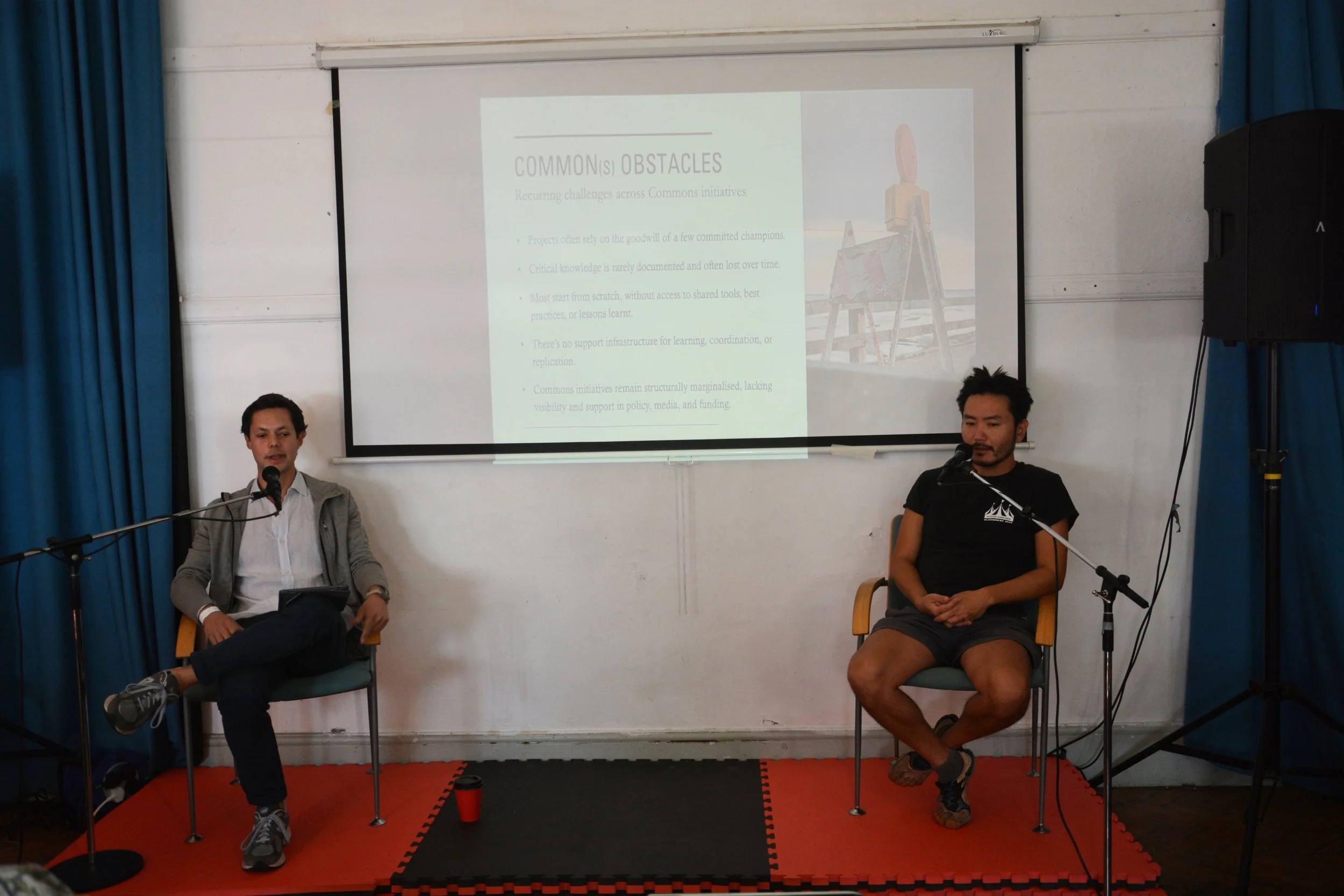
Commons Lab was first presented publicly at the 2025 Festival of Commoning, where it drew strong interest from practitioners across the UK and beyond. The message was clear: there was a need within the ecosystem for a dedicated organisation to capture and share the practical knowledge emerging from these projects.
We incorporated as a non-profit in early 2026 to take this work forward – making these approaches accessible beyond their place of origin.
The organisation
Commons Lab is incorporated as a non-profit Company Limited by Guarantee (CLG) in England. Its structure is deliberately designed to serve a public purpose: it has no shareholders, and any surplus is reinvested rather than privately distributed. Our sector models, playbooks, and learning resources will be made available under open licences so they can be used, adapted, and built on by others.
Looking ahead
As this body of work develops, we will explore how the organisation itself might evolve. We see Commons Lab not only as an organisation that supports the Commons, but as one that should gradually become part of it. This means moving towards a more participatory model in which the communities, practitioners, and collaborators who use and contribute to this work also play a meaningful role in shaping and stewarding it.
The team
Commons Lab is currently led by its three co-founders who combine complementary backgrounds and expertise.

Michel Rauchs
Michel specialises in the design of alternative financial and economic models that serve communities rather than extract from them. After leading the digital assets research programme at the University of Cambridge Judge Business School for several years, he shifted his work toward repurposing proven tools from banking and finance specifically for the commons. At Commons Lab, he focuses on the integrated design framework that underpins the sector models.

Chikara Shimasaki
Chik brings years of experience in cultural dynamics and practical commoning, shaped through leading roles in commons initiatives and four years at the Organisation for Identity and Cultural Development (OICD). His work focuses on what makes commons projects hold together over time – how shared identity forms, how participation is sustained, and how governance remains genuinely democratic as a project grows. At Commons Lab, he is the primary link to partner communities in the field.

Fran Erazo
Fran works at the intersection of urban strategy, spatial design, and community engagement as the founder of Culturans in Mexico City. Drawing on his background in architecture, he specialises in closing the "implementation gap" – structuring partnerships across academia, government, and industry to translate sustainability concepts into built reality. At Commons Lab, he helped develop the core operational framework into an applied engine for commons-based solutions.
Our collaborator network
We’re not doing this on our own.
Our small core team is supported by a wider network of collaborators who contribute specialist knowledge, experience, and perspective across different disciplines and sectors. This network is one of our strongest assets – developed through years of shared work and engagement with practitioners, researchers, and initiatives working on commons-based and related approaches.
Community organising
Governance
Design
Finance
Technology
Identity & culture
Public policy
Economics
Law
Media & comms
This network brings together expertise across economic and financial systems, legal and governance design, and the social and cultural dynamics of collective action. It includes practitioners who have pioneered many of the tools and mechanisms that inform our integrated design framework, as well as communities already active across various provisioning sectors – some of which are involved in our pilot work.
These relationships allow us to draw on a broad base of knowledge and practical experience, without which our work would not be possible.
We continue to develop this network over time.
If you are working in a related area and would like to get involved, we’d love to hear from you.