Our Approach
The gap
Communities across sectors face structural challenges that limit their ability to succeed in the long run.
Successful community projects often lack the time and resources to document best practices or guide others – so knowledge stays fragmented and effective models rarely spread.
Without accessible, ready-to-use playbooks, communities rebuild legal, governance, financial, and cultural structures themselves – duplicating effort, missing proven lessons, and increasing the risk of fragile design.
Communities often operate with unstable, short-term grants that leave core work underfunded, driving them toward bank loans or investor capital whose terms introduce extractive pressures that put shared assets at risk.
Active participation is the lifeblood of any commons project, but it is hard to maintain over time as initial enthusiasm fades, key contributors step back, and groups struggle to preserve a shared identity and internal cohesion.
Poor legal and governance structures expose communities to existential risks: projects can drift away from commons principles – becoming susceptible to commercial interests or internal hierarchies – or grind to a halt when decision-making breaks down.
Even successful initiatives often remain isolated nodes, lacking the horizontal federation to coordinate with peers and the vertical integration to interact across sectors – holding back the emergence of a broader, interconnected Commons Economy.
There is plenty of commons activity, but little commons infrastructure to support it.
The intervention
Commons Lab responds by building the missing commons infrastructure that projects can rely on:
We create strong design foundations that give new projects the best possible head start.
We distill key lessons into practical sector guidance that communities can readily apply.
We develop ecosystem capacity so proven models can be independently replicated elsewhere.
The backbone
At the heart of our approach lies the Integrated Commons Toolkit (ICT), a holistic design framework that addresses the root causes of fragility in many commons projects.
We see the ICT as a new kind of operating system for resilient commons. It helps communities build coherent systems that remain robust, adaptable, and alive over time – by integrating dimensions that are usually treated in isolation.
Legal & Governance
Legal & governance structures that permanently lock shared assets under community control, protect projects against capture or mission drift, and embed partnership structures that share risks and rewards among stakeholders.
Social & Cultural
Social & cultural practices that foster trust, a shared identity, social cohesion, and active member participation – the living core of any commons.
Economic & Financial
Economic & financial mechanisms that decouple projects from extractive finance, enabling communities to raise funds without traditional equity or debt and to keep value circulating locally.
These dimensions are usually addressed separately – if at all.
But in practice, they form a single, interdependent system where choices in one dimension influence the conditions for the others: a funding model sets incentives and power, legal structures determine how these are constrained or distributed, and social dynamics shape how these arrangements are created, maintained, and adapted. The ICT starts from this premise, approaching commons design from the outset as an integrated whole rather than assembling it from separate parts over time.
The process
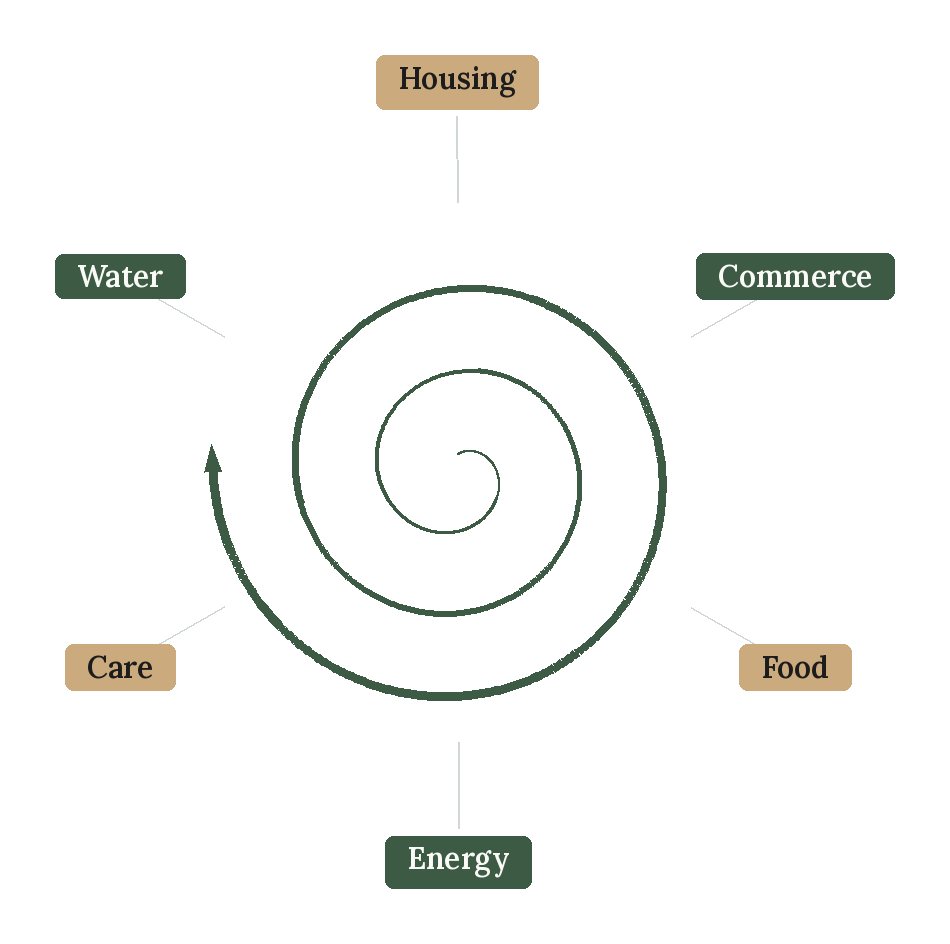
Across the provisioning sectors we work on, our approach follows an iterative process that moves from early design to field testing to supporting the conditions for wider adoption.
Each stage strengthens the next and feeds learning back into the whole.
Develop a core sector model
Using the ICT, we develop an initial model for a specific sector (e.g. housing), weaving together legal, governance, financial, social, and cultural elements into a coherent but flexible design structure.
Test the model in real community contexts
We partner with local communities to put the model into practice – testing key assumptions, observing what holds under real-world conditions, and learning from practical implementation challenges.
Codify lessons into a field-tested playbook
We translate insights from pilots into a public playbook: a practical guide that offers step-by-step guidance other communities can adapt to their own context.
Iterate the core model through field feedback
We feed lessons from real-world use back into the underlying sector model, refining its architecture so it evolves in step with actual needs, conditions, and constraints.
Build ecosystem capacity for independent replication
We develop a distributed network of trained enablers who support communities in applying our models in new contexts, helping ensure confidence and responsible use.
Repeated across sectors.
We repeat this process across key sectors – energy, food, care, water, and more – building an expanding portfolio of field-tested models and playbooks that support the emergence of a wider Commons Economy.