Why Commons?
A stronger foundation
The most secure foundation for any society is one where communities have the power to provide for themselves.
When people come together to steward the essentials of life – housing, food, energy, care – the systems they build tend to reflect the realities they live in. They are shaped by those who depend on them, and in turn remain more accessible, affordable, and often more resilient than those driven primarily by profit or policy.
Yet for most of us, the opposite experience has become familiar. Today, the basics of life feel increasingly uncertain. Housing is harder to secure, public services are stretched thinner, living costs continue to rise, and the spaces that once held communities together are quietly disappearing.
Beneath these everyday pressures lies a growing sense that decisions are made elsewhere, leaving us with little influence over the conditions that shape our lives. This is not accidental. It reflects the underlying structure of the economic and financial systems that govern our modern lives: dependent on continual expansion, they tend to extract wealth, concentrate power, and erode the social and natural resources that make life worthwhile.
And yet, this is not the only way things can be organised. Across the world, people are already responding – drawing on a tradition far older than the crises it addresses.
What is the Commons?
The Commons describes a way of collectively organising shared resources so that they can be used, maintained, and passed on over time.
A commons is typically defined by three interdependent elements: a shared resource (physical or immaterial), a community of people who use and steward it, and a set of rules and practices they develop together to ensure accountability, fair access, and long-term care
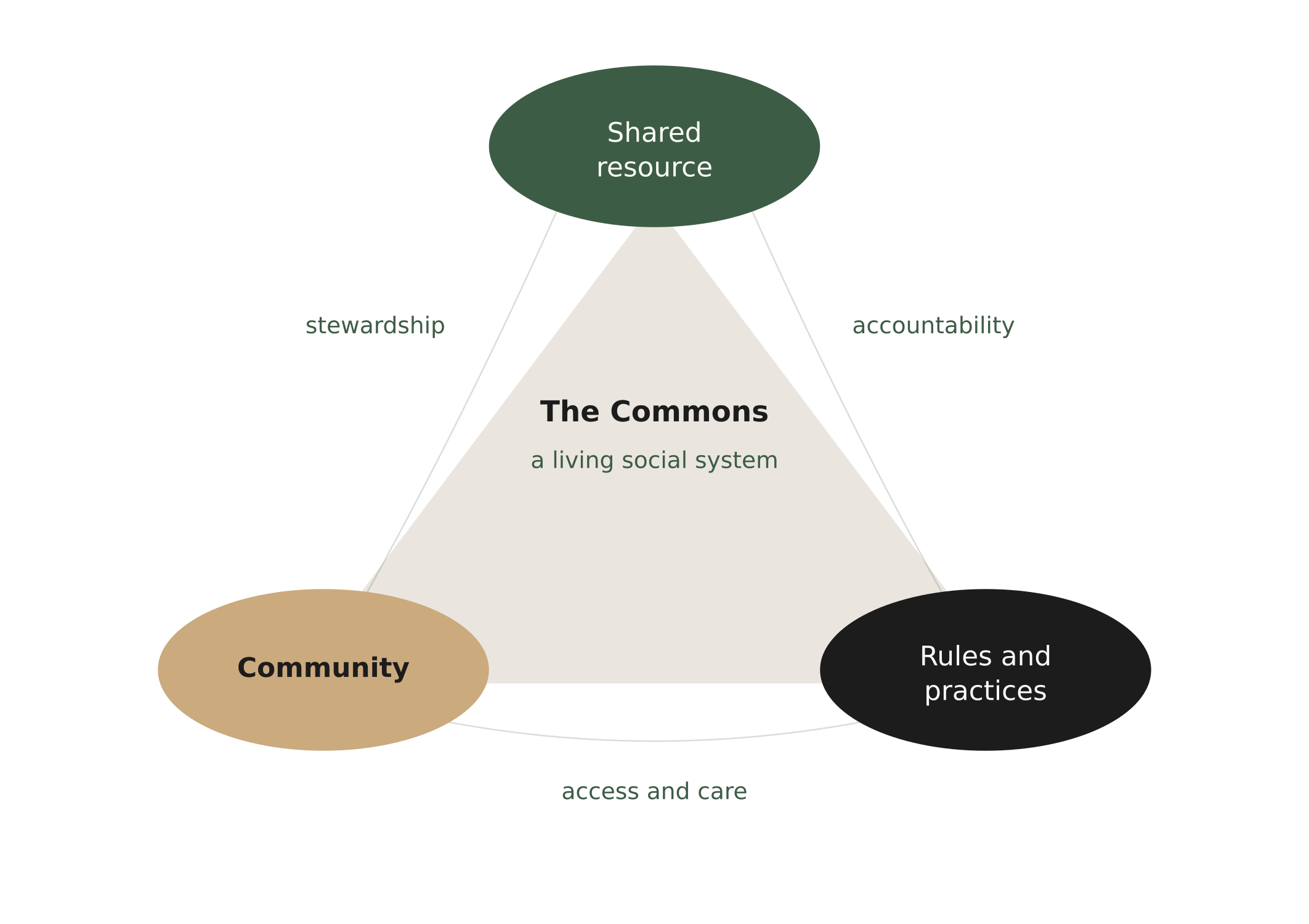
These elements are inseparable: what makes something a commons is not the resource itself, but the community and web of relationships around it. Because those who rely on the resource are also involved in maintaining it, responsibility and benefit remain closely aligned. A commons is a living social practice, not a “thing” – and as a result no two commons look exactly the same.
Commons can be found in many forms, both past and present. Historically, they governed shared forests, fisheries, and farmland. Today, they exist in community energy systems, food networks, and the software code that underpins much of our digital infrastructure.

Swiss alpine pastures
For over seven hundred years, villages in the Swiss Alps have collectively managed mountain pastures. Each spring, neighbours gather to decide which slopes will be grazed first, how many cattle each household may bring, and when to move the herds so the land can recover. These local commons are often linked through regional cooperatives that coordinate quality standards and the marketing of alpine products such as cheese.

Wikipedia
Wikipedia, the world’s largest encyclopedia and one of the most visited websites on the planet, is a knowledge commons with millions of registered users worldwide. Its content is freely available, collectively edited by tens of thousands of volunteer contributors, and governed by community rules – without advertising, shareholders, or central editorial control.

Dudley Street, Boston
In the 1980s, residents of Boston's Roxbury neighbourhood created one of the first urban community land trusts in the United States. The Dudley Street Neighbourhood Initiative has secured over thirty acres of abandoned land for permanently affordable housing, gardens, and public spaces – becoming the first community in the US to win the legal power to reclaim neglected land for collective use.

FECOFUN, Nepal
Nepal's Federation of Community Forestry Users unites over 23,000 community forest groups, collectively managing nearly a third of the country's forested land. Each group governs its own forest, setting rules for access, harvesting, and regeneration. The federation connects them across districts and regions, pooling resources, sharing knowledge, and representing their interests at the national level.
For millennia, fisheries, forests, grazing lands, and waterways were held in common. Communities across every continent developed local arrangements for managing these shared resources, using practices and rules embedded in customary law and mutual obligation. In many traditions, relationships to land, water, and living systems carried a reverential, even spiritual dimension – nature was something to be cared for, not exploited. Far from being primitive arrangements, these were sophisticated institutions that sustained ecosystems and livelihoods across generations.
This changed with the rise of capitalism and the nation state. Beginning in Europe and spreading through colonial expansion, commons were systematically enclosed over several centuries. Land was fenced, forests logged, waterways diverted, and entire communities displaced. Customary rights that had been honoured for generations were revoked and replaced by legal ownership structures that prioritised private property and commercial use. The process was deliberate: it freed up land, labour, and resources for commercial enterprise and imperial ambition. By the nineteenth century, the practice of commoning had been pushed to the margins in much of the world.
In 1968, biologist Garrett Hardin gave this marginalisation an intellectual stamp of approval that provided economists and policymakers with a ready-made rationale for further enclosure. His influential essay "The Tragedy of the Commons" argued that individuals sharing a resource would inevitably overuse and destroy it – unless it was privatised or placed under state control. For decades, this framing dominated academic and policy thinking, reinforced by the political and economic shifts of the 1970s and 1980s that accelerated deregulation and privatisation across much of the world.
The intellectual turning point came in 1990, when political scientist Elinor Ostrom published a landmark study drawing on decades of fieldwork. She documented how communities around the world had long governed shared resources successfully, and showed that commons were often more sustainable and adaptive than comparable market or state arrangements. In 2009, she became the first woman to receive the Nobel Memorial Prize in Economic Sciences. Alongside this intellectual rehabilitation, a practical resurgence was already underway: driven by the rise of the Internet, countless projects demonstrated that digital commons could thrive at a global scale, without centralised ownership or state control.
A forgotten pillar
If the Commons is so fundamental, how did it come to be largely forgotten?
For most of human history – long before large-scale markets or states existed – the Commons was the dominant way communities organised to provide for themselves, second only to the household. That this tradition is now largely invisible is not an accident, but the result of centuries of systematic repression and marginalisation.
Today, we have come to rely so heavily on markets and the state that we have largely forgotten this third mode of provisioning, even though it is far older than either. Restoring the Commons is not about rejecting markets or dismantling the state. It is about recovering a vital third pillar – one that complements and moderates the other two, so that each can do what it does best while covering the gaps the others leave behind.
Forgotten for centuries. Ready to be restored.
Common(s) myths
Still, the Commons remains widely misunderstood – it doesn’t fit neatly into the categories we’re used to. To clear some of this confusion, let’s be explicit about what it is not.
Not anti-state, but critical of distant, centralised bureaucracies
Commons do not seek to replace the state, but to rebalance where decisions are made. In practice, many commons complement public services and work alongside supportive local government. The guiding principle is subsidiarity: keeping decisions as close as possible to those affected by them.
Not anti-market or anti-money, but against speculation and extraction
Many commons use market tools and various forms of money where appropriate, but in a way that supports real exchange and circulation, rather than speculation or accumulation.
Not anti-profit, but opposed to growth at any cost
Commons may generate surpluses, but resist models that depend on continuous expansion or shift costs onto others. Any surplus is reinvested in – and shared by – the community that created it, while ensuring the underlying resource is sustained.
Not against private property, but against enclosure
What the Commons resists is not private property as such, but enclosure – the process that converts shared wealth into private gain, excluding others from access and benefit.
Not ideological or partisan, but pragmatic and pluralistic
The Commons cuts across traditional political divides and sidesteps rigid ideological framing. It enables thriving small businesses and decentralised innovation (which resonates with conservatives); practises fairness and pre-distribution by design (which appeals to the left); favours local supply chains and ecological stewardship (which greens value); and reduces dependence on centralised state bureaucracies (which libertarians welcome).
It fits no existing box – and that’s precisely its strength.
Towards a Commons Economy
“The next big thing will be a lot of small things.”
Commons do not begin with grand plans or sweeping reforms. They start at the margins, in small circles where people know and trust each other: a group of neighbours securing land for housing, a community organising its own food system, or local businesses finding new ways to trade and support each other. They do not seek to overthrow what exists, but build something better that works for them.
When the benefits become tangible, others take notice. What begins as isolated efforts gradually spreads through imitation: projects learn from one another, adapt what works, and experiment for themselves. Over time, as these local initiatives multiply and connect, they begin to form networks of mutual support and exchange – small islands of shared provision that, together, lay the foundations of a different kind of economy.
As economic structures change, so does the culture and experience around them. When you help govern something you depend on – an apartment building, a food network, a shared space – the relationship becomes different. You are no longer a passive customer or recipient relying on distant providers. Instead, you become an active participant in something you help create and sustain: with a real say in how it works, a genuine stake in the outcomes it produces, and a shared responsibility in keeping it going.